
A Primer on Acupuncture
by Sajid Surve, DO | February 3, 2009 Traditional acupuncture is an ancient chinese art which was passed down from master to apprentice for over 4,000 years, based on anecdotal evidence, trial and error, and an Eastern philosophy of the universe. Its practice was outlawed in China after the Revolution of 1911 in favor of allopathic medicine, during a time when China wanted to appeal to Western civilization. However, in the 1950s Chairman Mao ordered a reorganization and integration of the two philosophies, and the resultant consensus became what is referred to today as “Traditional Chinese Medicine” or TCM. TCM is an entire system of medical practice, with the primary focus being on herbology. Other elements include acupuncture, moxibustion, cupping, scraping, coining, and some bone-setting, all of which are meant to support the action of the herbs.
By contrast, medical acupuncture is a system that focuses on acupuncture as a complete modality in and of itself, and is modeled more after the French style of acupuncture energetics. For a full discourse on the origins and rationale behind medical acupuncture, I cannot do better than my teacher, Dr. Joseph Helms, who is the founder of American medical acupuncture. Dr. Helms played a huge role in the import of acupuncture into the United States in the 1970s.
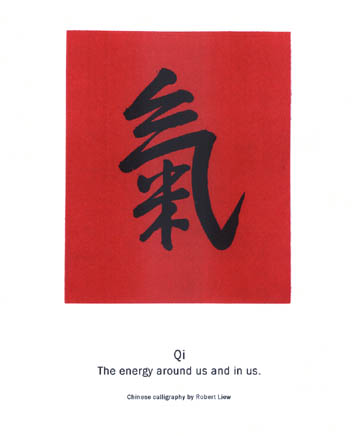
The basic premise behind the Eastern worldview is that the whole universe is filled with and governed by qi (pronounced “chee”). Qi is a sort of vital energy, an essence, an ideal. It has gone by several names throughout civilizations, like prana in yoga concepts, Ruah in ancient Hebrew scripts, mana in polynesian folklore, Holy Spirit in Christianity, and miwi to the Aborigines. The literal derivative of the symbol for Qi is “the vapor formed from the consumption of rice.” Perhaps that gives some insight into the energy implied. In Eastern philosophy, everything has qi, both animate and inanimate objects.
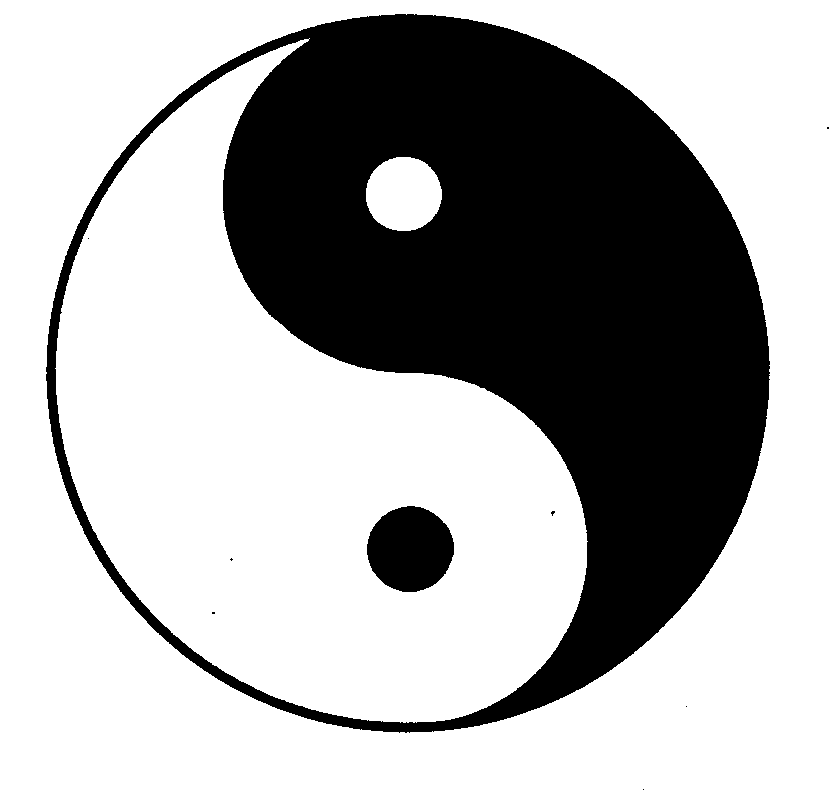
The expression of all of the universe’s qi can be summed up as a balance between two opposites, the yin and yang. This part can sometimes become confusing, because Eastern philosophy uses yin and yang to describe ALL opposites. Yin is down, and yang is up. Yin is solid, and yang is liquid. Yin is front and yang is back. Yin is cold and yang is hot. In the case of the classic image of yin and yang, yin is black and yang is white. At the center of yin is a little yang, and vice versa, as in Eastern philosophy nothing is 100% one or the other; instead all are considered shades of gray. As an example, consider yin as down and yang as up. A bird flying in the sky is yang with respect to the ground, but it is also yin with respect to the clouds. In that way the bird is both yin and yang, depending on perspective. Obviously though, if the bird is flying only a few feet above the ground, it is expressing much more yin than if it were flying as high as it could. As such our actions, emotions, and state of mind determine how much yin and yang we express at any given time.
In the body, yin and yang expressions of qi travel down defined channels called meridians. We have 20 main meridians which are the primary movers of qi, and hundreds of subdivisions which are able to shunt, bypass, and connect the various meridians. 8 of the meridians, called the curious meridians, provide the body with polarity and help to define direction for the other meridians to travel. They also have a degree of influence over the qi in other meridians which flow through their domain. The remaining 12 meridians are called the principal meridians, and their qi originates from one of the 12 vital organs in the body (kidney, heart, small intestine, bladder, spleen, stomach, lung, large intestine, liver, gallbladder, “master of the heart” or “pericardium,” and “triple heater” or “san jiao”). These organs produce their own unique qi , which has its own purpose and sphere of influence in our body, mind, and spirit.
Disease, then, is the disruption of the flow of qi through the meridians, or the over/underexpression of one particular type of qi. Acupuncture, in the simplest of terms, is the diagnosis of which meridians are affected and how they are affected, and then using needles (or other tools) to access the qi of the meridians to help restore balance of flow.
Share This Article
Further Reading
Sajid Surve, DO
Sajid Surve, DO, is a physiatrist, acupuncturist, and osteopath who specializes in musculoskeletal medicine and integrative medicine. See All Posts By The Author
New ‘Brain Games’ Exclusive Preview – Times Square Mass Mind Reading
This Sunday February 14th (9 p.m. ET), the Emmy-nominated Brain Games tv-show is back! Wonder junkie Jason Silva returns to our screens, teaming up with... READ MORE →
Like what you read? Give to Brain Blogger sponsored by GNIF with a tax-deductible donation.
Make A Donation